Press briefings
that fight back
Dispatch trains government spokespeople, senior leaders, and communications directors to hold their line when hostile journalists push back. AI journalists with distinct voices, an ambush mechanic, and a rotating press pack. Every briefing ends with a Dispatch Debrief that tells you exactly how you performed - and exactly how you gave ground.
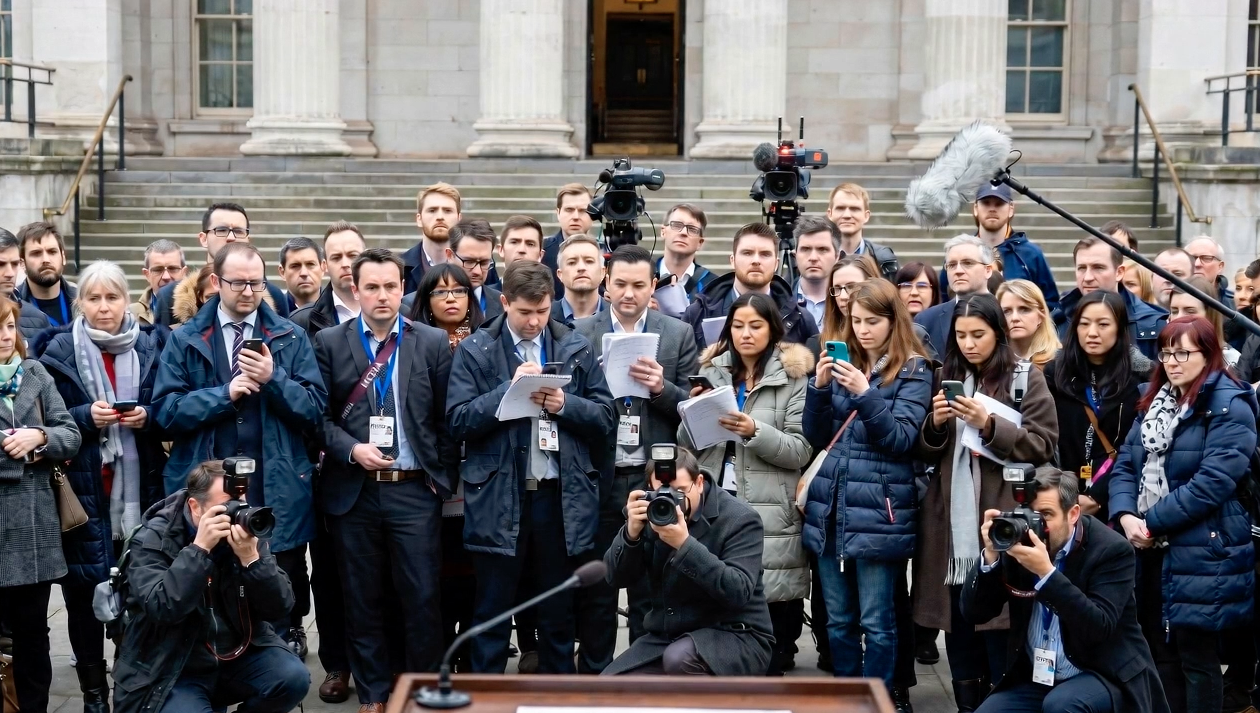
Media training does not replicate what a hostile briefing feels like
Every senior official and communications lead has been on a media training course. They have learned the technique. They know to bridge, to pivot, to stay on message. But knowing technique and executing it under sustained hostile questioning from journalists who have done their homework are entirely different competencies - and standard training develops only the first.
"Reputations are not lost in the incident. They are lost in the response to it. The difference between organisations that emerge from a crisis stronger and those that do not is almost entirely down to how they communicated in the first 48 hours."
Cabinet Office Communications, Crisis Communications Guidance for Government SpokespeopleA trainer playing a journalist is not a journalist
Role-play journalists in media training courses are sympathetic, paced, and predictable. Real journalists interrupt, pivot without notice, return to the same question in a different form, and co-ordinate across the press pack. The gap between simulated and real is where spokespeople are caught out.
Ambush questions cannot be rehearsed
The questions that damage reputations are not the ones on the brief. They are the tangential question at minute 14 that the spokesperson was not expecting, asked quietly by a journalist who has done more preparation than the communications team anticipated. No standard training exercise replicates this.
Performance goes unmeasured
A media trainer observing a role-play can tell you what felt wrong. They cannot tell you that you answered the journalist's framing on 64% of hostile questions, or that your on-message rate dropped from 80% to 42% in the final third of the briefing when you were tired. That level of precision requires a different approach.
Senior leaders cannot access training at pace
Scheduling a proper media training exercise for a Director General, Minister, or Chief Constable takes weeks and requires a room, a camera crew, and a trainer. When a crisis breaks on a Tuesday evening, none of that is available. Dispatch is available whenever the spokesperson is - and produces a debrief within minutes of completion.
A full press pack in a room you can access at any time
Dispatch creates a realistic AI press briefing environment. The spokesperson faces a rotating panel of journalists - each with a distinct voice, a different publication agenda, and a question quota per cycle. The journalists interrupt, follow up, and co-ordinate. One carries an ambush question - an unexpected angle raised matter-of-factly at a natural break in the briefing.
Dispatch journalists are not playing a role. They are driven by separate AI instances with individual agendas, individual memories of what the spokesperson has already said, and the ability to pick up on inconsistencies between one answer and the next. When the spokesperson contradicts themselves, the journalists notice - exactly as a real press pack would.
- Three AI journalists per briefing, each with a distinct voice and outlet agenda
- Rotating question structure - each journalist gets a quota per cycle, then the pack rotates
- Ambush mechanic - one journalist introduces an unexpected angle after turn 3
- Live coaching panel (optional) - real-time guidance on bridging and message delivery
- On-message tracking across every response throughout the briefing
- Dispatch Debrief generated on completion - full performance analysis cited to transcript
The spokesperson reads the briefing statement
Before the briefing begins, the spokesperson receives the scenario briefing statement - the incident, the organisation's position, and the approved messaging lines. This is the only information they hold when the journalists enter. No speaker notes, no script.
The press briefing begins
Three AI journalists, each rendered as a realistic avatar with a distinct voice, begin the briefing in rotation. Questions are generated from the scenario context and the journalist's individual publication agenda. One journalist holds an ambush question - an angle not covered in the briefing statement - which they raise at a natural point after the briefing is underway.
Live coaching (optional)
If enabled, a coaching panel provides real-time guidance as the briefing proceeds. When the spokesperson drifts from the messaging brief, accepts a hostile framing, or misses a bridging opportunity, a coaching note appears. In assessment mode, the spokesperson works without the guide.
Dispatch Debrief generated
On completion, the Dispatch Debrief is produced: on-message rate per journalist and across the briefing, hostile questions handled without concession, messages successfully delivered, bridging technique analysis, and a narrative of where the spokesperson held their line and where they gave ground - with specific examples from the transcript.
Four crises. One press pack. No script.
Each scenario comes with a full briefing statement, three journalists with individual agendas, and a pre-loaded ambush question. The spokesperson's only tool is their preparation - and the technique they have trained.
The Embassy Protest
A protest outside a foreign embassy in London has escalated to a forced entry. The Metropolitan Police has made 12 arrests. The Foreign Office spokesperson faces questions about the diplomatic implications, the security response, and whether advance intelligence was acted on. The ambush concerns a prior incident at the same location six months earlier.
The Data Breach
A Home Office contractor has reported a data breach affecting 340,000 citizen records. The breach was identified 72 hours ago but the public announcement was delayed. The spokesperson must address questions about the delay, what data was accessed, what has been offered to those affected, and what accountability follows. The ambush concerns a Freedom of Information request that was refused in the weeks before the breach.
The Ministerial Statement
A junior Minister has made an unscripted comment in a Select Committee that appears to contradict departmental policy. The departmental spokesperson faces questions about whether the Minister's statement represents government policy, whether the Minister has been briefed correctly, and whether this signals a wider rift. The ambush is a direct quote from a six-month-old departmental document that the journalist has obtained.
The Industrial Incident
A fire at a waste processing facility has caused a chemical release affecting a residential area. Eleven people have been taken to hospital. The agency spokesperson must address questions about the regulatory inspection history of the site, whether warnings were issued and acted on, what the health risk is to nearby residents, and what is being done in the next 24 hours. The ambush concerns a critical inspection report published and later quietly amended.
The Dispatch Debrief
Every completed Dispatch session generates a Dispatch Debrief - a structured performance report that goes beyond "you did well" or "you struggled under pressure." It measures, cites, and advises - at the level of specific exchanges, specific journalists, and specific moments where the spokesperson's line held or bent.
The debrief is immediately shareable with the communications director and the training lead. For senior leaders who do not often receive honest feedback on their media performance, the debrief provides something they rarely get: an objective account of precisely what happened.
Pre-crisis preparation
Senior leaders and spokespeople run Dispatch sessions before a known upcoming announcement or event - a difficult Ministerial statement, a Select Committee appearance, an impending enforcement decision. The debrief shows exactly what to practise before the real event.
Communications team development
Communications leads run Dispatch across their team and use the debrief data to identify which spokespeople are genuinely ready for a hostile briefing and which need further preparation. Comparable data replaces subjective impression.
Live crisis warm-up
When a crisis breaks, the spokesperson runs the most relevant Dispatch scenario in the minutes before the real briefing. The debrief highlights the bridging gaps and framing risks to fix before facing the actual press pack.
Assessed against the standards your comms team already uses
Dispatch debrief dimensions are mapped to government communications frameworks. There is no proprietary scoring rubric to explain or justify to a Chief Communications Officer.
The OASIS framework (Objective, Audience, Strategy, Implementation, Scoring) is the GCS planning standard for all government communications campaigns. Dispatch debrief dimensions map to the Audience and Strategy phases - how well the spokesperson understood the journalists' agendas and whether their responses consistently delivered the strategic message.
- Message clarity and consistency
- Audience-specific response calibration
- Strategic message delivery rate
- Bridging and pivot technique
COBR crisis communications doctrine emphasises three principles for spokesperson performance in an active crisis: factual accuracy under uncertainty, consistent messaging across spokespeople, and the 48-hour narrative window. Dispatch scenarios are built around the highest-pressure phase of COBR protocol - the first press contact after an incident is declared.
- Accuracy under uncertainty
- Consistent message delivery
- 48-hour window management
- Hostile question handling under COBR pressure
FCDO communications leads operate in environments where a mistimed statement or accepted journalist framing can carry diplomatic consequences. The Embassy Protest and Ministerial Statement scenarios are built specifically for FCDO context - covering diplomatic sensitivity, cross-departmental messaging alignment, and the handling of questions that touch on intelligence or operational matters.
- Diplomatic framing discipline
- Cross-departmental message alignment
- Sensitive question handling
- International audience awareness
The questions you will need to answer
When the permanent secretary asks how you know your spokespeople are ready, or when a Director General wants to prepare for tomorrow's Select Committee, Dispatch gives you something concrete to show.
"How do I know which of my spokespeople will hold their line under hostile questioning?"
The Dispatch Debrief produces comparable data across your spokesperson pool. On-message rate, hostile question handling, and bridging technique are all measured and cited to specific exchanges. You can identify who is genuinely ready and who needs targeted preparation before a real briefing.
"We have a Select Committee appearance in three days. How do we prepare the Minister?"
Dispatch is available immediately. Run the most relevant scenario today, receive the debrief tonight, and use the specific gaps it identifies to focus preparation tomorrow. No scheduling, no camera crew, no waiting for a media trainer to be available. The debrief tells you exactly where to direct preparation effort.
"We already run media training. What does Dispatch add that we do not already have?"
Media training develops knowledge of technique. Dispatch develops the application of that technique under realistic hostile pressure - and produces an objective record that media training cannot. Dispatch is not a replacement for media training. It is the practice environment that makes media training stick.
See Dispatch demonstrated
We run live demonstrations for communications directors, senior spokespeople, and L&D leads. The demonstration covers a complete briefing session with the journalist queue live, a walk-through of the coaching panel, and the full Dispatch Debrief on completion.